ADCs for CPAP
 An
Analog-to-Digital Converter
(ADC or A/D converter) measures the magnitude of an input analog signal and converts it to a digital number
that is proportional to the magnitude of the voltage or current. An
ADC
often converts real-world signals to digital signals for processing. One of the more important
specifications of an ADC is the resolution that it offers, which is the number of discrete values
(represented in bits) that the ADC produces in relation to the analog signal it is converting. The more
bits, the higher the resolution. A higher resolution yields a more accurate approximation of the analog
input.
An
Analog-to-Digital Converter
(ADC or A/D converter) measures the magnitude of an input analog signal and converts it to a digital number
that is proportional to the magnitude of the voltage or current. An
ADC
often converts real-world signals to digital signals for processing. One of the more important
specifications of an ADC is the resolution that it offers, which is the number of discrete values
(represented in bits) that the ADC produces in relation to the analog signal it is converting. The more
bits, the higher the resolution. A higher resolution yields a more accurate approximation of the analog
input.
Audio Amplifiers for CPAP
 A
power
or
audio amplifier
is typically used to greatly increase the signal strength, or amplitude, of a current or voltage signal. In
audio applications
, late stage "power" amplifiers in a signal chain can be used to increase the power output of a signal such
that the signal can physically move, or drive, the diaphragms in a loud speaker.
A
power
or
audio amplifier
is typically used to greatly increase the signal strength, or amplitude, of a current or voltage signal. In
audio applications
, late stage "power" amplifiers in a signal chain can be used to increase the power output of a signal such
that the signal can physically move, or drive, the diaphragms in a loud speaker.
Op Amp - Current Shunt Monitor for CPAP
 Current-shunt
or
current sense amplifiers
are special purpose amplifiers that measure electrical current. These amplifiers output a voltage that is
proportional to the current flowing in the power rail, or the supply/return to the load relative to ground.
There are two references to current-shunt placement: low-side refers to the return path from the load and is
usually at a low voltage to ground. High-side is with respect to the supply path to the load and is usually
at a high voltage to ground. The decision to place a
current shunt
in either position needs to be assessed based on the particular application.
Amplifiers
should introduce as little noise as possible so that the signal transfers an accurate measure of what it is
sensing. Amplifiers can be identified by the device they are intended to drive (e.g., audio amplifier), the
input that they are to amplify (e.g. sensing amplifier), the frequency range of the signal (e.g., RF,
audio), and by the function that they perform (e.g. buffer or
current-shunt amplifier
.)
Current-shunt
or
current sense amplifiers
are special purpose amplifiers that measure electrical current. These amplifiers output a voltage that is
proportional to the current flowing in the power rail, or the supply/return to the load relative to ground.
There are two references to current-shunt placement: low-side refers to the return path from the load and is
usually at a low voltage to ground. High-side is with respect to the supply path to the load and is usually
at a high voltage to ground. The decision to place a
current shunt
in either position needs to be assessed based on the particular application.
Amplifiers
should introduce as little noise as possible so that the signal transfers an accurate measure of what it is
sensing. Amplifiers can be identified by the device they are intended to drive (e.g., audio amplifier), the
input that they are to amplify (e.g. sensing amplifier), the frequency range of the signal (e.g., RF,
audio), and by the function that they perform (e.g. buffer or
current-shunt amplifier
.)
Op Amp - Buffer for CPAP
A
buffer amplifier
serves to isolate one part of a circuit from another, providing electrical impedance transformation from one
circuit to another. There are two main types of buffers: voltage and current. Both are used, respectively,
to transfer either voltage or current from a primary circuit with low output impedance to another circuit
with high input impedance. The
buffer amplifier
, in between the two circuits, prevents the secondary circuit from loading the primary circuit and
interfering with desired operation of the primary circuit. Amplifiers have enormous voltage gain, often use
feedback of the output signal back to the input of the amplifier to operate, and can be classified in
different ways. They can be identified by the device they are intended to drive (e.g., audio amplifier), the
input that they are to amplify (e.g. sensing amplifier), the frequency range of the signal (e.g., RF,
audio), and by the function that they perform (e.g.
buffer amplifier
, current-shunt amplifier.)
Sensor Amplifiers for CPAP
These
sensor amplifiers
increases the amplitude of weak signals it receives while introducing as little noise as possible so that
the signal transfers an accurate measure of what it is sensing.
Amplifiers
have enormous voltage gain, often use feedback of the output signal back to the input of the amplifier to
operate, and can be classified in different ways. They can be identified by the device they are intended to
drive (e.g., audio amplifier), the input that they are to amplify (e.g.
sensing amplifier
), the frequency range of the signal (e.g., RF, audio), and by the function that they perform (e.g. buffer
amplifier, current-shunt amplifier.)
Clocks for CPAP
 There are two purposes for
clocks
in electronics: to act as a hardware
timing clock
that governs the synchronization digital devices, and as a
real-time clock
(
RTC
), which keeps accurate time with respect to the end-user for record-keeping purposes. Whereas it is
possible to keep time for external users with a digital circuit timing clock, it’s not as reliable as a RTC
with battery back-up. Digital clock technology keeps electronics synchronized and is more expensive and
complicated at higher frequencies. A lower frequency clock can be used and then multiplied to achieve the
desired clock rate for digital devices; however any jitter (error) is also multiplied. (Jitter is shakiness
in the signal, caused by electro-magnetic radiation or the influence of nearby signals.) Circuitry
supporting clock function should be selected for low noise so as not to introduce error.
There are two purposes for
clocks
in electronics: to act as a hardware
timing clock
that governs the synchronization digital devices, and as a
real-time clock
(
RTC
), which keeps accurate time with respect to the end-user for record-keeping purposes. Whereas it is
possible to keep time for external users with a digital circuit timing clock, it’s not as reliable as a RTC
with battery back-up. Digital clock technology keeps electronics synchronized and is more expensive and
complicated at higher frequencies. A lower frequency clock can be used and then multiplied to achieve the
desired clock rate for digital devices; however any jitter (error) is also multiplied. (Jitter is shakiness
in the signal, caused by electro-magnetic radiation or the influence of nearby signals.) Circuitry
supporting clock function should be selected for low noise so as not to introduce error.
Current Sensing Amplifier for CPAP
Current sensing amplifiers
, also known as current-sense or current-shunt amplifiers, measure electrical current. The voltage across a
resistor in a current path is directly proportional to that current, per Ohm's law. Thus, measuring current
is highly dependent upon the resistor for accuracy. Integrated circuits for current measurement are more
efficient, accurate, and are an overall lower cost solution over a discrete current-sense solution.
Audio DACs for CPAP
 A
digital-to-analog converter
(
DAC
) is a semiconductor device that is used to convert a digital code (usually binary) into an analog signal,
such as electric charge, current, or voltage. A DAC is the principal means by which computer and
digitally-based systems translate digital data into real-world signals. An audio-quality
DAC
has specifications tuned for
audio applications
such as a high dynamic range with low to no distortion.
A
digital-to-analog converter
(
DAC
) is a semiconductor device that is used to convert a digital code (usually binary) into an analog signal,
such as electric charge, current, or voltage. A DAC is the principal means by which computer and
digitally-based systems translate digital data into real-world signals. An audio-quality
DAC
has specifications tuned for
audio applications
such as a high dynamic range with low to no distortion.
DC/DC Controller for CPAP
 DC/DC controllers
are integrated chips that offer programmable and highly adjustable power management beyond that of standard
DC/DC converters. Both are important in battery-powered devices because they can conserve power, extend
battery life, and regulate voltage. Electronic systems often have several sub-circuits, each with its own
voltage level requirement that may be higher or lower than the main power supply. Over time, battery voltage
levels decline as stored power is drained. DC/DC converter circuits can raise or lower voltage levels,
allowing a circuit to continue operation.
DC/DC controllers
also offer options such as multiple softstart levels, undervoltage lockout, protection against overvoltage
and undervoltage, and programmable short-circuit protection. One advantage of DC/DC converting ICs is that a
portable device can use just one battery rather than multiple batteries to accomplish desired voltage
levels.
DC/DC controllers
are integrated chips that offer programmable and highly adjustable power management beyond that of standard
DC/DC converters. Both are important in battery-powered devices because they can conserve power, extend
battery life, and regulate voltage. Electronic systems often have several sub-circuits, each with its own
voltage level requirement that may be higher or lower than the main power supply. Over time, battery voltage
levels decline as stored power is drained. DC/DC converter circuits can raise or lower voltage levels,
allowing a circuit to continue operation.
DC/DC controllers
also offer options such as multiple softstart levels, undervoltage lockout, protection against overvoltage
and undervoltage, and programmable short-circuit protection. One advantage of DC/DC converting ICs is that a
portable device can use just one battery rather than multiple batteries to accomplish desired voltage
levels.
Digital Isolators for CPAP
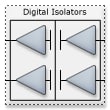 Isolation
is critical to protect both an electronics system and the user from potentially hazardous voltages, or where
a high level of electrical isolation between electronics systems is necessary. Considerations for digital
isolators are speed of data transmission, high level of magnetic immunity, and long life expectancy. Used in
combination with isolated power supplies, these devices block high voltages, isolate grounds and prevent
noise currents from entering the local ground and interfering with or damaging sensitive circuitry.
Digital isolators
can be used to implement isolation in designs without the cost, size, power, performance, and reliability
constraints found with optocouplers.
Isolation
is critical to protect both an electronics system and the user from potentially hazardous voltages, or where
a high level of electrical isolation between electronics systems is necessary. Considerations for digital
isolators are speed of data transmission, high level of magnetic immunity, and long life expectancy. Used in
combination with isolated power supplies, these devices block high voltages, isolate grounds and prevent
noise currents from entering the local ground and interfering with or damaging sensitive circuitry.
Digital isolators
can be used to implement isolation in designs without the cost, size, power, performance, and reliability
constraints found with optocouplers.
LED Drivers for CPAP
 LED drivers
are a constant-current source commonly used to power LEDs for screen backlighting.
LED
s are current-driven devices whose brightness is proportional to the magnitude of forward current flow.
Typical desired features for an
LED driver
are direct control of current, high efficiency, PWM dimming, overvoltage protection, load disconnect, small
size, and ease of use.
LED drivers
are a constant-current source commonly used to power LEDs for screen backlighting.
LED
s are current-driven devices whose brightness is proportional to the magnitude of forward current flow.
Typical desired features for an
LED driver
are direct control of current, high efficiency, PWM dimming, overvoltage protection, load disconnect, small
size, and ease of use.
MOSFET Drivers for CPAP
 Designers of power electronic circuits must often drive power switches that feed DC, AC, or power signals to
a variety of loads. Logic-level electronic circuits always provide the driving signals. In general, however,
the power sources and their loads have reference levels different from that of the control circuitry
(ground).
MOSFET
selection begins by choosing devices that can handle the required current, then giving careful consideration
to thermal dissipation in high current applications.
Designers of power electronic circuits must often drive power switches that feed DC, AC, or power signals to
a variety of loads. Logic-level electronic circuits always provide the driving signals. In general, however,
the power sources and their loads have reference levels different from that of the control circuitry
(ground).
MOSFET
selection begins by choosing devices that can handle the required current, then giving careful consideration
to thermal dissipation in high current applications.
Processors for CPAP
 The term "
processor
" refers to an electronic device that performs computational functions and carries out the instructions of a
stored program. Other terms for processor are microprocessor, central processing unit, and digital signal
processor. Essentially, the processor refers to "the brains of a computer."
The term "
processor
" refers to an electronic device that performs computational functions and carries out the instructions of a
stored program. Other terms for processor are microprocessor, central processing unit, and digital signal
processor. Essentially, the processor refers to "the brains of a computer."
Sensors for CPAP
 A CPAP device requires
sensors
that assists in regulating the pressure, flow rate, temperature, and humidity of the air that is forced
through the mask to create the positive air pressure for the wearer. Pressure to the wearer cannot be too
great or too little, because although the wearer's airway needs to be forced open for breathing, it cannot
be so great as to be more uncomfortable than necessary. The air must also be warmed to a temperature
compatible the human body and moistened so that the wearer's air passages do not dry to the point of
discomfort. Despite attention to the wearer's comfort level, the biggest problem for CPAP treatment is
non-compliance by wearers due to discomfort while trying to sleep.
A CPAP device requires
sensors
that assists in regulating the pressure, flow rate, temperature, and humidity of the air that is forced
through the mask to create the positive air pressure for the wearer. Pressure to the wearer cannot be too
great or too little, because although the wearer's airway needs to be forced open for breathing, it cannot
be so great as to be more uncomfortable than necessary. The air must also be warmed to a temperature
compatible the human body and moistened so that the wearer's air passages do not dry to the point of
discomfort. Despite attention to the wearer's comfort level, the biggest problem for CPAP treatment is
non-compliance by wearers due to discomfort while trying to sleep.
Speakers for CPAP
 In any
audio application
,
speakers
are the components that take the stored electronic signals and turn them back into actual sound, supplying
the end-result of the audio system for listeners to hear. Speakers can be used for audio applications from
providing a local alarm buzzer, reproduction of original sound via playback through speakers, to
sophisticated audio applications like noise cancellation.
In any
audio application
,
speakers
are the components that take the stored electronic signals and turn them back into actual sound, supplying
the end-result of the audio system for listeners to hear. Speakers can be used for audio applications from
providing a local alarm buzzer, reproduction of original sound via playback through speakers, to
sophisticated audio applications like noise cancellation.
Step-Down Converters for CPAP
 A
step-down
, or
buck converter
, is a DC-to-DC power converter with an output voltage that is lower than its input voltage. Although one
can use a linear regulator to reduce the voltage, step-down converters are much more efficient. Step-down
converters consume less power as well as operate at cooler temperatures. Electronic systems often have
several sub-circuits, each with its own voltage level requirement that may be higher or lower than the main
power supply, therefore step-down converters may be required. Since the output voltage of the buck is lower
than the input voltage, it follows that the output current must be higher than the input current.
A
step-down
, or
buck converter
, is a DC-to-DC power converter with an output voltage that is lower than its input voltage. Although one
can use a linear regulator to reduce the voltage, step-down converters are much more efficient. Step-down
converters consume less power as well as operate at cooler temperatures. Electronic systems often have
several sub-circuits, each with its own voltage level requirement that may be higher or lower than the main
power supply, therefore step-down converters may be required. Since the output voltage of the buck is lower
than the input voltage, it follows that the output current must be higher than the input current.
Step-Down Regulators for CPAP
 A
step-down
(
buck
)
regulator
maintains a constant output voltage level that is lower than its input voltage while preserving polarity.
Electronic systems often have several sub-circuits, each with its own voltage level requirement that may be
lower than the main power supply, therefore
step-down regulators
may be required. The switching regulator offers the advantages of high power conversion efficiency and
increased design flexibility; multiple output voltages of different polarities can be generated from a
single input voltage. Since the output voltage of the buck is lower than the input voltage, it follows that
the output current must be higher than the input current.
A
step-down
(
buck
)
regulator
maintains a constant output voltage level that is lower than its input voltage while preserving polarity.
Electronic systems often have several sub-circuits, each with its own voltage level requirement that may be
lower than the main power supply, therefore
step-down regulators
may be required. The switching regulator offers the advantages of high power conversion efficiency and
increased design flexibility; multiple output voltages of different polarities can be generated from a
single input voltage. Since the output voltage of the buck is lower than the input voltage, it follows that
the output current must be higher than the input current.
Touch Screens for CPAP
 A
touch screen
is an electronic visual display that can detect the presence and location of a touch within the display
area. A
resistive touch screen
works by applying a voltage across a resistor network and measuring the change in resistance at a given
point on the matrix where a screen is touched by an input stylus, pen, or finger. The change in the
resistance ratio marks the location on the touch screen. With most
capacitive touch screen
panels, touching the surface of the screen changes the screen's electrostatic field, which is measured as a
change in capacitance. There are different technologies to determine the location of the touch; but in any
case the location is then sent to the controller for processing. Unlike a resistive touch screen, most
capacitive touch screens cannot be used with electrically insulating material, such as gloves.
A
touch screen
is an electronic visual display that can detect the presence and location of a touch within the display
area. A
resistive touch screen
works by applying a voltage across a resistor network and measuring the change in resistance at a given
point on the matrix where a screen is touched by an input stylus, pen, or finger. The change in the
resistance ratio marks the location on the touch screen. With most
capacitive touch screen
panels, touching the surface of the screen changes the screen's electrostatic field, which is measured as a
change in capacitance. There are different technologies to determine the location of the touch; but in any
case the location is then sent to the controller for processing. Unlike a resistive touch screen, most
capacitive touch screens cannot be used with electrically insulating material, such as gloves.
Touch Screen Controllers for CPAP
 A
touch screen controller
interacts with the touch screen sensor (located between the display and a protective lens that the user
touches) to measure tiny changes in capacitance or resistance. The changes are then translated into digital
signals. The touch screen controller interfaces to the host processor to indicate finger/stylus positions,
taps, and other useful input. Some important considerations are the
touch screen controller's
accuracy, environmental compensation techniques, ability to handle noise, and efficacy of algorithms.
A
touch screen controller
interacts with the touch screen sensor (located between the display and a protective lens that the user
touches) to measure tiny changes in capacitance or resistance. The changes are then translated into digital
signals. The touch screen controller interfaces to the host processor to indicate finger/stylus positions,
taps, and other useful input. Some important considerations are the
touch screen controller's
accuracy, environmental compensation techniques, ability to handle noise, and efficacy of algorithms.
USB for CPAP
 USB
is a standard connection interface between computers and digital devices. A USB transceiver is a physical
layer device that prepares data for transmission and then sends to, and receives data from, another
transceiver. The transceiver detects connection and provides the low level USB protocol and signaling. The
term "transceiver" indicates an implementation of both the transmit and receive functions. It transmits and
receives, encodes and decodes data, provides error indication, implements buffers to stage data until it can
be managed, and adjusts for the clock rate from the serial stream on the
USB SuperSpeed
bus to match that of the "link layer" higher up on the communication stack.
USB
is a standard connection interface between computers and digital devices. A USB transceiver is a physical
layer device that prepares data for transmission and then sends to, and receives data from, another
transceiver. The transceiver detects connection and provides the low level USB protocol and signaling. The
term "transceiver" indicates an implementation of both the transmit and receive functions. It transmits and
receives, encodes and decodes data, provides error indication, implements buffers to stage data until it can
be managed, and adjusts for the clock rate from the serial stream on the
USB SuperSpeed
bus to match that of the "link layer" higher up on the communication stack.
USB Receptacle for CPAP
 USB plugs
and
receptacles
are meant to reduce human error by their unique shape; they fit together in only one way. USB plugs and
receptacles come in Type A (typically connecting to hosts or hubs) or Type B (typically connecting to
devices) and 3 sizes: standard, mini, and micro. Type A plugs always face upstream, Type B faces downstream.
USB plugs
and
receptacles
are meant to reduce human error by their unique shape; they fit together in only one way. USB plugs and
receptacles come in Type A (typically connecting to hosts or hubs) or Type B (typically connecting to
devices) and 3 sizes: standard, mini, and micro. Type A plugs always face upstream, Type B faces downstream.
Voltage REF for CPAP
 A
voltage reference
produces a constant level of voltage over time regardless of load, changes in power supply or temperature.
Voltage references are used in power supplies, analog-to-digital converters, digital-to-analog converters,
and many other applications where voltage levels must be maintained at a steady level or precision is
greatly affected or the device would be rendered inoperable. Voltage references can vary greatly in
performance. A
voltage reference
for a power supply might hold its output to within only a few per centage points off of its nominal or
stated value, however a voltage reference to instrumentation-level standards are measured in parts per
million regarding stability and precision to the nominal or specified value.
A
voltage reference
produces a constant level of voltage over time regardless of load, changes in power supply or temperature.
Voltage references are used in power supplies, analog-to-digital converters, digital-to-analog converters,
and many other applications where voltage levels must be maintained at a steady level or precision is
greatly affected or the device would be rendered inoperable. Voltage references can vary greatly in
performance. A
voltage reference
for a power supply might hold its output to within only a few per centage points off of its nominal or
stated value, however a voltage reference to instrumentation-level standards are measured in parts per
million regarding stability and precision to the nominal or specified value.
Voltage Supervisors for CPAP
 Supply
Voltage Supervisors
monitor the primary voltage that feeds embedded electronics circuits for low voltage conditions, thus
improving system reliability. Voltage supervisors ensure a proper system power-up and power-down and work to
provide an environment for a smooth and trouble-free system. For example, a
voltage supervisor
can be made to reset a controller if supply voltage conditions are too low for proper operation of the
controller and keep it in a reset mode until the unstable supply voltage conditions resolve.
Supply
Voltage Supervisors
monitor the primary voltage that feeds embedded electronics circuits for low voltage conditions, thus
improving system reliability. Voltage supervisors ensure a proper system power-up and power-down and work to
provide an environment for a smooth and trouble-free system. For example, a
voltage supervisor
can be made to reset a controller if supply voltage conditions are too low for proper operation of the
controller and keep it in a reset mode until the unstable supply voltage conditions resolve.
AC / DC Power Supply for CPAP
 An
AC/DC adapter
is a type of external power supply, often enclosed in what looks like an over-sized AC wall-plug. Other
names include power adapter, power converter, plug-in adapter, adapter block, domestic mains adapter, line
power adapter, or simply AC adapter. AC adapters are used with electrical devices that require DC power but
do not have the internal circuitry to accomplish the conversion of AC to DC. Medical-grade power supplies
are designed to meet the IEC60601-1 medical equipment safety standard and may include typical output
voltages of 3.3 to 48 Vdc, a variety of package style (open-frame, enclosed, encapsulated, etc.), mounting
options, thermal management, and environmental features, among others.
An
AC/DC adapter
is a type of external power supply, often enclosed in what looks like an over-sized AC wall-plug. Other
names include power adapter, power converter, plug-in adapter, adapter block, domestic mains adapter, line
power adapter, or simply AC adapter. AC adapters are used with electrical devices that require DC power but
do not have the internal circuitry to accomplish the conversion of AC to DC. Medical-grade power supplies
are designed to meet the IEC60601-1 medical equipment safety standard and may include typical output
voltages of 3.3 to 48 Vdc, a variety of package style (open-frame, enclosed, encapsulated, etc.), mounting
options, thermal management, and environmental features, among others.
ESD Protection for CPAP
 If you have ever been zapped by a socks-wearing kid who has just discovered static charge build up, you have
experienced ESD first hand. ESD is like a miniature, localized lightning bolt caused by an electrical
discharge.
ESD
can have seriously damaging effects on an integrated chip or system, or can cause poor performance or
failure later on by merely weakening the circuits.
If you have ever been zapped by a socks-wearing kid who has just discovered static charge build up, you have
experienced ESD first hand. ESD is like a miniature, localized lightning bolt caused by an electrical
discharge.
ESD
can have seriously damaging effects on an integrated chip or system, or can cause poor performance or
failure later on by merely weakening the circuits.